05 June 2012
New Staghorn Coral Nursery at Tennessee Reef
25 May 2012
Welcome Brevard Community College
| Environmental Club of BCC (Melbourne) |
Professor Scott Herber of Brevard Community College brought the Environmental Club of BCC's Melbourne campus to KML for the school's inaugural visit. Students had an excellent opportunity to get a first hand look at the ecology of the Florida Keys coral reefs ecosystem. Students were also able to compare and contrast the mangrove systems of the Indian River Lagoon, near BCC, with those of the Florida Keys giving them a unique insight into the aquatic ecological diversity of Florida. Although not all students were initially comfortable immersing themselves in the marine environment by the end of their trip, with the help of Professor Herber and KML staff, all students took the plunge. Professor Herber plans to continue bringing groups of students from BCC to KML in the future.
17 April 2012
FSU Class Visits KML
A reef ecology graduate class from FSU visited KML to take advantage of a beautiful week of weather here in the Florida Keys. The class was led by Markus Huettel, whose lab's work focuses on the ecology of coastal and shelf environments with emphasis on processes in the sediments and at the sediment-water interface. During their time here at KML they were able to visit a variety of sites, deploying sampling equipment, surveying reef life, and even taking advantage of KML's Living Laboratory. With the help of the KML science staff the Huettel group was able to deploy non-invasive instruments utilizing new techniques to measure vertical oxygen flux at the sea bottom. Vertical oxygen flux is vital in understanding processes such as aerobic decomposition of organic matter, animal respiration, and oxidation processes.
| FSU divers with sampling equipment |
| Deploying oxygen flux measuring equipment |
Of the variety of sites that were visited during the week, Alligator Reef, a favorite of many groups, gave students the opportunity to observe a variety of marine life including the threatened Elkhorn coral, Acropora palmata.
| Acropora palmata at Alligator Reef |
FSU student swims transect line back to the boat
|
KML staff orients students on Living Lab
|
29 February 2012
KML Open House
21 February 2012
A Lobster's Point of View: Life in the Florida Keys
KML will host the 3rd in a series of Science Seminars in the KML classroom at 6:30pm Tuesday February 21st. Fish & Wildlife Research Institute's marine biologist, Tom Matthews, will give a 20-30 minute talk on Florida's spiny lobsters and how they "see" their world under the waves here in the Keys. There will be opportunity to ask Tom questions following the talk. Seating is limited so call the office to reserve a spot.
16 December 2011
Celebrating 20 years at KML

09 December 2011
Welcome Trevor, new KML staff scientist

Trevor Luna joined the KML team as a Biological Scientist for FWC/FWRI in December of 2011. He graduated with a Bachelors of Arts in Biology from Rollins College in Winter Park, FL before moving to Zambia, Africa to serve in the U.S. Peace Corps. There he worked with the Zambian Department of Livestock and Fisheries as an Aquaculture Extension Agent promoting rural Tilapia culture. Trevor is an avid boater, diver, fisherman and hunter. The KML team is very excited to have Trevor on board. Welcome Trevor!
01 November 2011
Adaptation to loacal environment in corals?
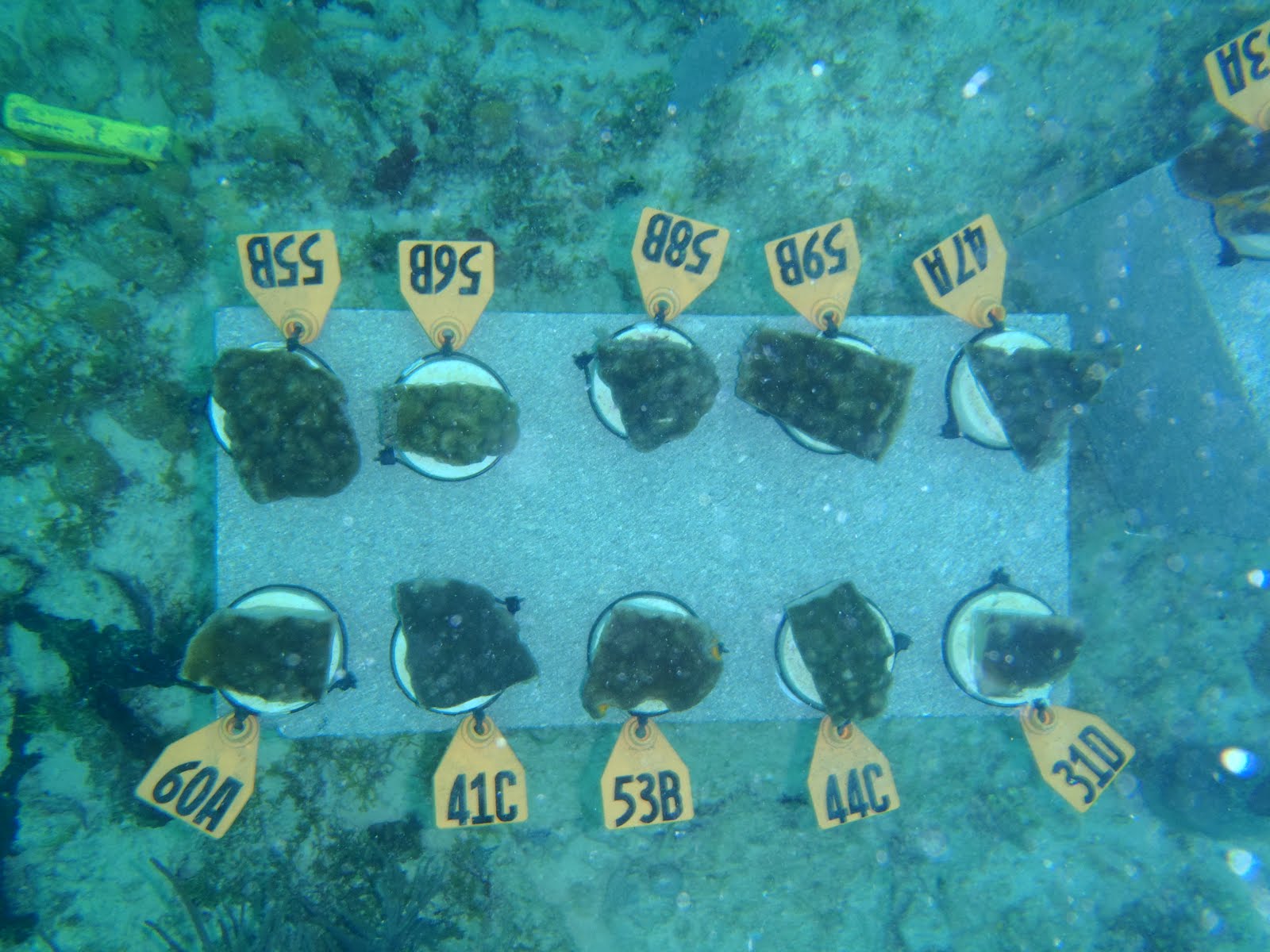
Are corals genetically adapted to different habitats, or are they able to change their physiology to match novel environmental conditions? Carly Kenkel, a PhD candidate from the University of Texas at Austin hopes to answer this question for her model coral species, the Mustard Hill Coral (Porites astreoides), in the Florida Keys. She came to KML to set-up a large reciprocal transplant experiment to test for local adaptation of P. astreoides to differing thermal environments in the Keys. Because she was only able to spend 5 days here, the KML staff scientists helped with her collections and field deployment of the experiment. KML divers collected 15 P. astreoides colonies from a near-shore and off-shore site.
Carly then fragmented these colonies using a tile saw, and mounted them on cement pucks with cattle tag labels to keep track of all the individuals.
Finally, Carly weighed all the fragments so that she can monitor growth during her experiment.