 |
| Day 1: New coral planulae emerge on the mother sea plume colony (November 23, 2016) |
 |
| Day 10: Planulae settling on tiles, mouth parts developing (photo by DJ Valent) |
 |
| Day 15: New recruits! Planulae metamorphosed and settled on pre-conditioned ceramic tiles, polyp tentacles beginning to develop. Baby corals were inoculated with photosynthetic algae (Symbiodinium) harvested from the mother colony. |
 |
| Day 21: Tentacles extended. These are octocorals (soft coral) so they have 8 tentacles on each polyp which capture small particles (zooplankton) from the water. Purple calcareous spicules (sclerites) are beginning to form in the base of the polyp, protecting the baby coral from predation. |
 |
| Day 21: Brownish tinge in tentacles 6 days after inoculation, is evidence of the uptake of Symbiodinium which photosynthetically provides nutrients to the growing coral. |
 |
| Day 23: More purple sclerites and brown algal symbionts visible |
 |
| Day 31 |
 |
| Spawning! Gamete bundles rise from an Elkhorn Coral colony - 10:50pm 3 nites after full moon (photo K Neeley) |
 |
| Divers head to the reef to monitor for spawning |
 |
| Diver Bill Ferrell rigging a marker buoy at sunset |
 |
| Elkhorn Coral colonies (Acopora palmata) |
 |
| Staghorn Coral (Acropora cervicornis) provides a sheltered bed for a juvenile parrotfish (photo C Lewis) |
 |
| Moonjellies dancing in the moon beams |
 |
| Diver checking on "tripod" of eddy correlation instruments at their monitoring site |
 |
| Despite several days of rough seas, the team returned to their site each day over a 10-day period to download data and re-deploy equipment. |
 |
| Capturing Bonnethead and juvenile Lemon and Nurse sharks temporarily held in the KML Mesocosym for transport |

Are corals genetically adapted to different habitats, or are they able to change their physiology to match novel environmental conditions? Carly Kenkel, a PhD candidate from the University of Texas at Austin hopes to answer this question for her model coral species, the Mustard Hill Coral (Porites astreoides), in the Florida Keys. She came to KML to set-up a large reciprocal transplant experiment to test for local adaptation of P. astreoides to differing thermal environments in the Keys. Because she was only able to spend 5 days here, the KML staff scientists helped with her collections and field deployment of the experiment. KML divers collected 15 P. astreoides colonies from a near-shore and off-shore site.

Healthy P. asteroides colony next to color reference card
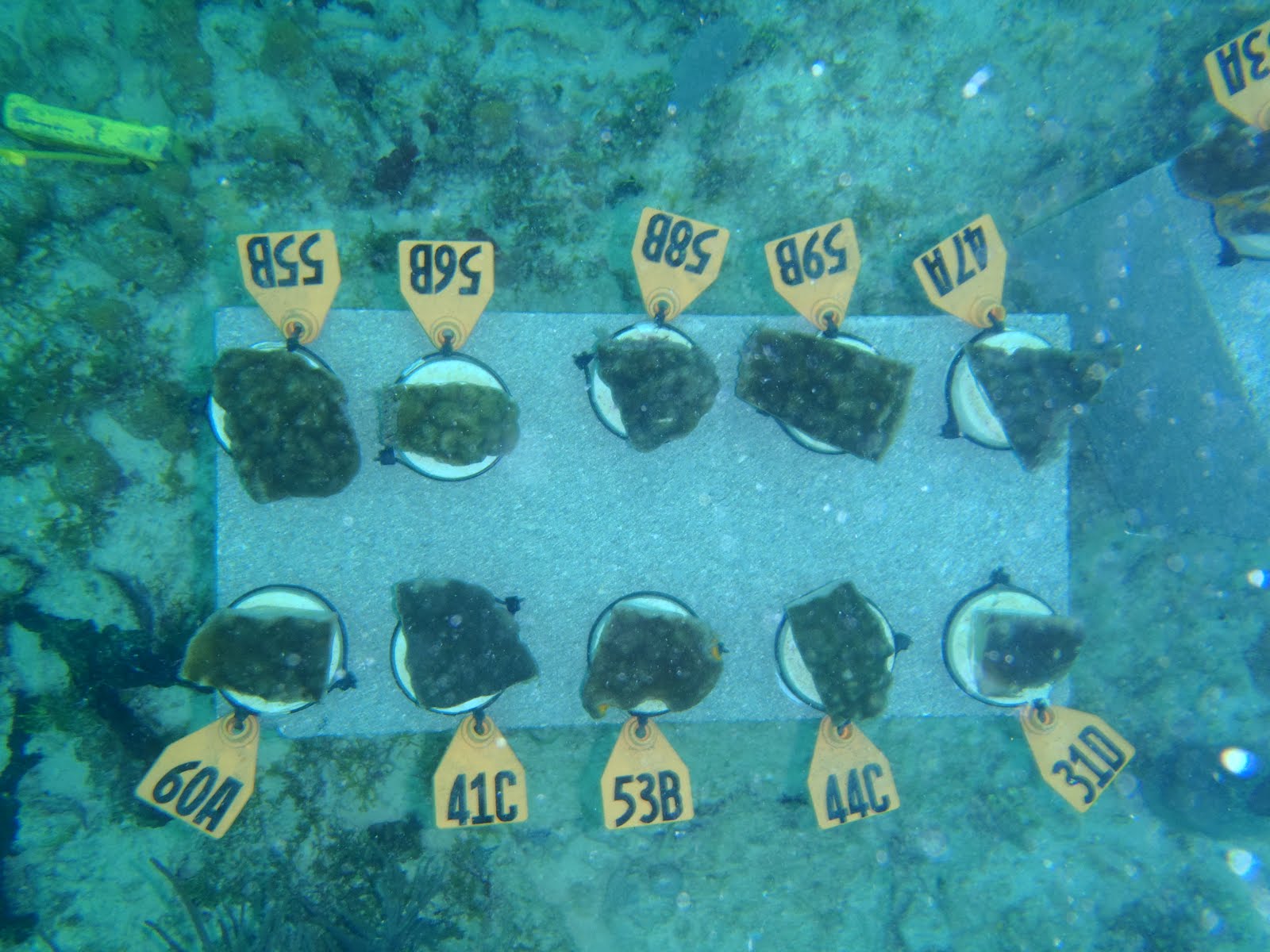
Carly then fragmented these colonies using a tile saw, and mounted them on cement pucks with cattle tag labels to keep track of all the individuals.

Finally, Carly weighed all the fragments so that she can monitor growth during her experiment.