01 November 2011

Adaptation to loacal environment in corals?


Are corals genetically adapted to different habitats, or are they able to change their physiology to match novel environmental conditions? Carly Kenkel, a PhD candidate from the University of Texas at Austin hopes to answer this question for her model coral species, the Mustard Hill Coral (Porites astreoides), in the Florida Keys. She came to KML to set-up a large reciprocal transplant experiment to test for local adaptation of P. astreoides to differing thermal environments in the Keys. Because she was only able to spend 5 days here, the KML staff scientists helped with her collections and field deployment of the experiment. KML divers collected 15 P. astreoides colonies from a near-shore and off-shore site.


Healthy P. asteroides colony next to color reference card

Carly then fragmented these colonies using a tile saw, and mounted them on cement pucks with cattle tag labels to keep track of all the individuals.

Finally, Carly weighed all the fragments so that she can monitor growth during her experiment.

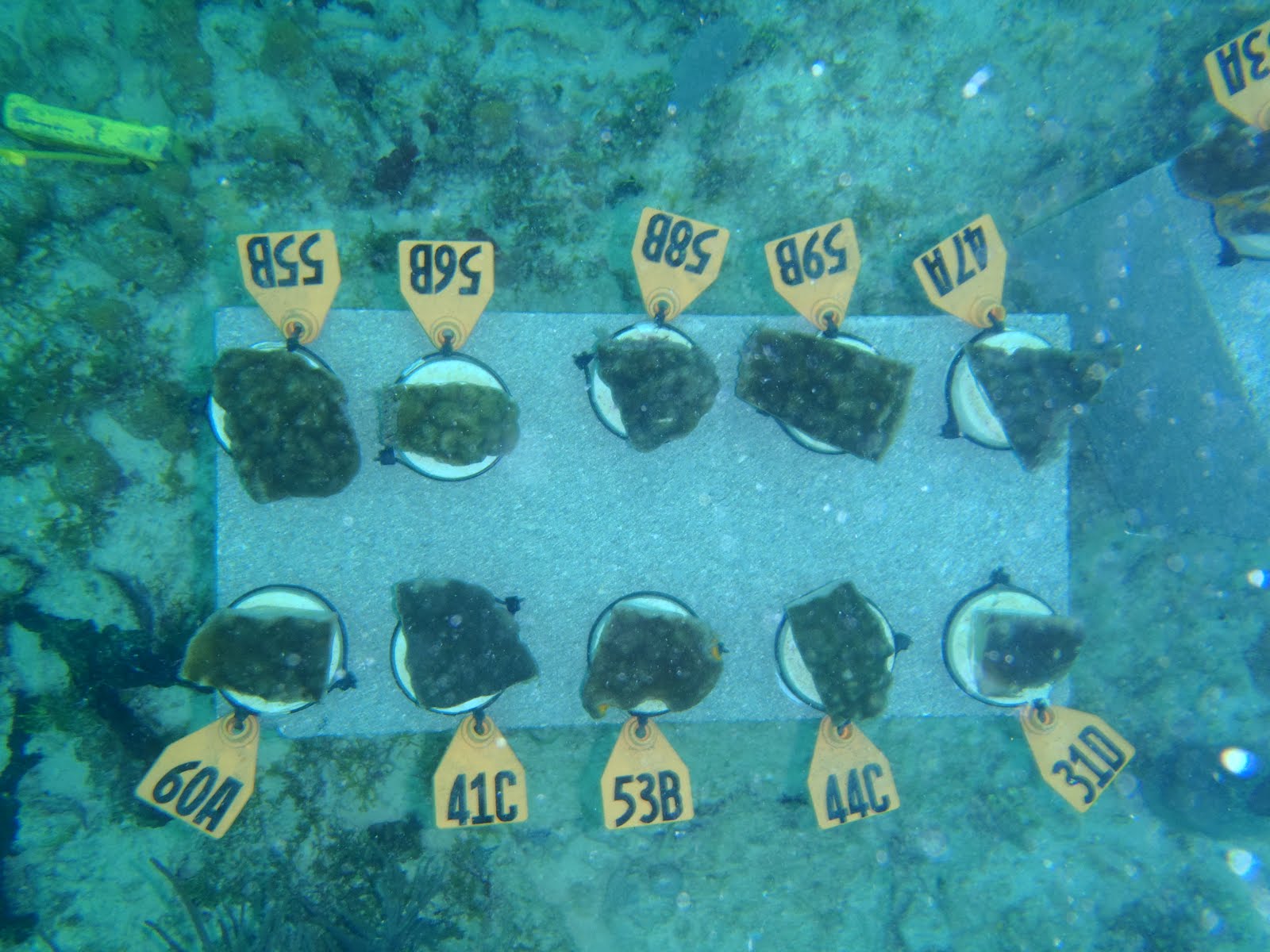
KML divers returned all the mounted fragments to her field sites, and she’ll be back in the spring and again in the fall to see if her predictions are correct!


19 October 2011

Spiny lobster denning behavior


What factors contribute to the denning behavior of Florida Bay's juvenile spiny lobster (Panularis argus) population? And how might shelter loss events, such as sponge die-offs, influence denning behavior and dispersal? What is the most effective way to conserve this important marine resource?
Katherine (Kat) Heldt, PhD candidate from Clemson University, has spent several months at KML, observing "social status" among lobsters and testing what mechanisms by which they choose shelters. Kat hopes to determine whether dominance status or familiarity can influence denning behavior and dispersal.

First, pairs of lobsters are housed in 15-gal replicate aquaria, plumbed to KML's seawater system. They are offered artificial shelter and observed at night for aggressive behavior under dim red lighting.

Next, the lobsters are transferred to KML's mesocosm ("The Shallows", KML's 122,000-gal flow-thru seawater pond) along with unfamiliar individuals (pairs housed in separate aquaria) equipped with artificial shelters. After several days of observing denning behavior and dispersal in the mesocosm, some of the shelter blocks are removed to mimic sudden habitat loss.

Finally, the tagged lobsters are released onto field sites (16 pre-selected 25m x 25m near-shore bay-side sites) for further observation.

Kat and her lab assistant, Frank, self-captain KML's 18' Parker, the R/V NariNari, to reach their sites.

01 October 2011

FAU students take a fish-eye view of marine habitats


No, this is not synchronized swim class. Dr. Stephen Kajiura, professor at Florida Atlantic University, brought 17 graduate students down to KML for their Sensory Biology and Behavior of Fish field trip in October. They spent 3 days exploring the various marine habitats, observing and discussing fish behavior.
Moving off the reef into deep water, students paired up to see how well they could navigate (ie swim a straight line) without visual references, such as being able to see the bottom. Students all agreed that they would make very poor fish. In another exercise, they were challenged to detect sounds of varying frequencies, while under water at varying depths and distances from the sound source.
Dr. Kajiura and his grad students are frequent visitors to KML, studying elasmobranch sensory abilities.

15 September 2011

BURR Team on hand for Coral Spawning Event in the Keys


Boulder Star Coral (Montastrea faveolata) setting gamete bundles prior to spawning (photo by P. Gillet)
Every August, several nights after the full moon, Boulder Corals along the Florida Keys reef tract synchronize their reproductive efforts in an amazing coral spawning event. Dr. Mary Alice Coffroth, professor at SUNY Buffalo, was on hand to capture the event for on-going projects exploring the many facets of coral-algal symbiosis.

An army of grad students, divers and snorkelers from Buffalo as well as volunteers from south Florida institutions, took to the water to arrange collection tents over promising colonies near Alligator Reef as dusk approached, then returned to the boat to wait. Teams of divers splashed again at 11:00pm to gather cupfuls of the coral spawn, handing them off to snorkelers who ferried them back to the boat. Weather was a bit rough but the team was fearless!

Returning to the dock at 2:00am, the army worked around the clock at KML's wet lab facility to carefully rear the developing coral larvae. Spawning was so successful at the Middle Keys site this year, that the BURR Team (Buffalo Undersea Reef Research) had plenty to share with fellow scientists in the Upper and Lower Keys.

The new coral recruits were allowed to settle on ceramic tiles in their special Kreisells at the wet lab and then placed back out on the reef to follow development. Dr. Coffroth's team will periodically return to KML to sample the new recruits on the tiles to asses the coral/algal symbiosis between near-shore and off-shore sites.

Check out the BURR blog for more on this project
: http://burrcoralspawn11.blogspot.com/