12 October 2009

Do rays modulate their feeding behavior with different prey types?

Samantha Mulvany
University of South Florida
Department of Biology
Tampa, FL

Samantha Mulvany, graduate student under Dr. Philip Motta at USF, spent several days at KML while capturing yellow stingrays (Urolophus jamaicensis) for her research project. Sam is studying the feeding kinematics in a variety of batoid species and is hoping to relate any kinematic findings to their morphology. Some derived batoids have cephalic lobes (lobes on the head) which aid in feeding. It will be interesting to see if having these cephalic lobes increases their ability to modulate feeding behavior or capture more elusive prey. Sam will be running phylogenetic comparisons to explore differences among species and determine any evolutionary correlations.

Bay side of Long Key: seawall overlooking a prime seagrass and hardbottom habitats where rays are typically spotted
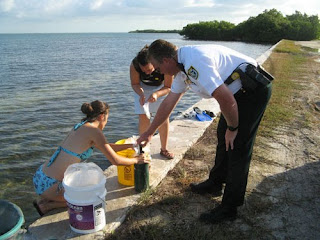
A visit from curious local law enforcement while collecting rays


Captured rays were transported back to USF for further behavioral studies.

09 October 2009

New dock lights and fresh pearock

Installation of 23 new dock bollards has recently been completed along KML's brand new concrete seawall. Each bollard has a low-voltage top light controlled by a photo-cell, providing ample lighting along the docks throughout the night. Spaced conveniently along the seawall, several of the bollards also have running fresh water for rinsing boats and power outlets (20 amp and 30 amp).View of bollards along the dock in the marina

View from the boat ramp along the north wall of the marina

Dock bollards looking north along the lagoon seawall


New dock bollards along the Lagoon seawall

Another important project at the Lab this Fall was finally grading off and spreading truckloads of fill and gravel to dress up the areas along the seawall and around the wet lab and Shallows. With the area freshly graded and new pea rock spread around the new Lagoon Gear Wash-down gazebo, looking towards the Wet Lab Pavilion

Freshly spread pearock along The Shallows

22 September 2009

New KML sign

The Keys Marine Lab has a new look by the office entrance show-casing the new KML logo

11 September 2009

Governor Crist at KML

Florida's governor, Charlie Crist, paid a brief vist to KML this week. The Governor and Florida Fish & Wildlife Conservation Commission Chairman, Rodney Barreto, were on their way to Marathon to assist with the release of a rehabilitated seaturtle. The Lab was a convenient stopping point for Governor Crist to change into more Keys-friendly attire. The Governor took a few moments to chat with staff before continuing on to the Turtle Hospital.

Cindy, Heddy, Lisa, Governor Crist, Dave, Bill, Commissioner Barreto

25 August 2009

Long Key Sea Turtle Nesting Season

As the sea turtle nesting season begins to wind down, it is time to look back to see how this season compared to last year.


The Keys Marine Lab's Biologist Andrew Crowder and his wife, Whitney, a ranger at Long Key State Park have monitored the beaches of Long Key again this year from April 15th until the end of October. This year they even added the Keys youngest sea turtle surveyor to the team, their son Finlee who will be 6 months old in a few days.


The first nest was laid right before the end of April, which was earlier than either of the last two previous years of monitoring, and there have even been crawls as late as the middle of this month. Last year the last crawl occurred at the beginning of July.


There haven't been any tropical storms or hurricanes that have seriously affected the Keys to date, knock on wood, but the raccoons have been busy again destroying all the eggs in 3 nests out at the point in the park. There have also been challenges for the sea turtle hatchlings with disorientations due to lighting, but all in all the nesting has been successful.


Manatee family visits KML

While preparing for a morning boat trip last week, we noticed a disturbance along the seawall in the lagoon in front of the wet lab. A pod of 6 manatees had cruised in to check out our seawater intake pipes and show off their new baby. They nibbled the algae on the PVC pipes and tickled their bellies with the seawater bubbler. Baby was very curious about our marker buoy. All 5 adults had terrible prop scars on their heads and backs from past encounters with boat motors. One manatee was actually missing almost half of its tail fluke. In spite of the temptation, we did not offer them drinks from our fresh water hose as this would only encourage them to return to dock areas and marinas, putting them in danger of further run-ins with boaters. We enjoyed their visit for over a half hour and then they moved on.

How well do sharks smell?

Tricia Meredith
Doctoral Candidate
Department of Biological Sciences
Florida Atlantic University
Boca Raton, FL


FAU PhD student, Tricia Meredith, recently conducted experiments at Keys Marine Lab to determine how well sharks can smell odors. There are many myths about the extreme olfactory sensitivity of these animals with very little scientific evidence to support these claims.


For this research Dr. Stephen Kajiura, Tricia, and a few volunteers long-lined for Bonnethead Sharks (Sphyma tiburo) in shallow seagrass meadows and mangrove habitats near Long Key. The sharks were quickly transported back to KML and kept in flow-through seawater tanks until used in the experiments. One female shark gave birth to 6 pups while in the holding tank over-night. All 6 pups can now be found swimming in KML's Shallows.


To determine the olfactory sensitivity of Bonnethead Sharks, they used a technique called an electro-olfactogram (EOG). During an EOG, odors are delivered into the nose of an immobilized shark while an electrode positioned over the olfactory organ detects the shark's response to the odor.

So far, Tricia has found that while sharks are very sensitive to odors, they are no more sensitive than bony fishes - disproving many of those shark myths.

06 August 2009

Coral Spawning Event in the Keys


Professor Mary Alice Coffroth, from the State University of New York at Buffalo, and a team of scientists, will be using KML as the base of operations in anticipation of the annual Montastrea faveolata (mountainous star coral) spawning event.
Each year these reef-building boulder coral sychronize their reproductive efforts, releasing gametes 4 to 7 days after the full moon in August and September. Follow the event at the Buffalo Underseas Reef Research (BURR) coral spawning blog.

The symbiosis between corals and photosynthetic dinoflagellate symbionts provides the foundation and structure of the coral reef ecosystem. Given the importance of this symbiosis to the coral-algal holobiont and the reef ecosystem, understanding the mechanism governing the establishment and long-term maintenance of this symbiosis is essential.
The over-all purpose of this project is to identify the mechanisms and selective processes that lead to the final assemblage of algal symbionts harbored by the adult coral.

04 August 2009

Bonnethead Shark pups at KML


A gravid bonnethead shark (Sphyma tiburo), gave birth to 6 live pups while being held for a visiting scientist in one of the large seawater tanks at the Lab .


Actively swimming at birth and measuring 8-10" from nose to tail, these miniature replicas of their mother have been transferred to our Shallows where they are chasing small fry and slurping squid tentacles.

28 July 2009

South Florida Student Shark Program

Graduate student Neil Hammerschlag, under the guidance of David Die, University of Miami-RSMAS, recently brought a group of students to KML for their June shark tagging in The Everglades National Park. The South Florida Student Shark Program is a partnership between the University of Miami, NOAA Living Marine Resources Cooperative Science Center, The Exlorers Club, and the Herbert W. Hoover Foundation. The research objectives focus on
1) determining the relative abundance, growth rates, and sex ratios of coastal shark species;
2) determining the presence and concentrations of mercury toxicity in coastal sharks;
3) characterizing sites important to the life history and ecology of sharks;
4) developing geographic information systems maps that incorportate data on shark population dynamics, genetics, eco-toxicity, and habitat use;
5) delineating areas of important for shark congregation, foraging, migration, and parturition as well as areas where sharks are susceptibale to bio-accumulation of mercury toxicity.

Bullshark being brought alongside the boat for measuring and taggingAnother important aspect of the project is to foster marine sciences, environmental stewardship mentoring, and public awareness through a network of interaction among high school, undergraduate and graduate students.


Magnificent 11' Great Hammerhead


14' Small-toothed Sawfish: Sawfish are an endangered species and require special permits to handle and tag. This fish was released unharmed, as quickly and safely as possible.


A very successful day in the field!
(photos by M. McCallister)